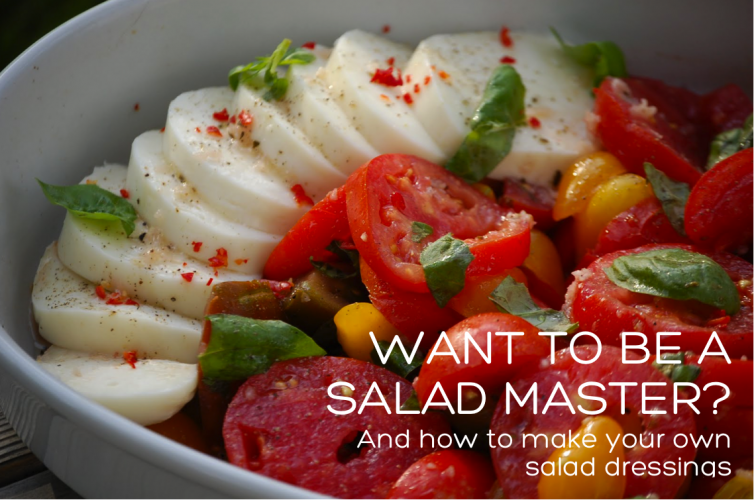
For anyone looking to eat better, feel better or lose weight, salads have got to be your friend.
Being able to whip up a delicious tasting salad is a boundless skill that empowers you to make a nutritious and delicious meal in 10-15 minutes. With just one good weekly shop, 10-15 minutes to make a delicious salad is way faster than heading out to any fast food joint and so much cheaper. It is also an easy way to incorporate your dietary proteins in the form of meat, chicken, fish and cheese.
As long as you have some good, large Tupperware containers (like from Ikea) and a small glass container with a screw-on lid (pesto or jam jars!), your salads can travel safely to work and be saved with-or-without a fridge until the mid afternoon.
For me, the first and most important thing is being able to make your own salad dressings. Store-bought dressing are very high in fat or sugars, always contain preservatives, and very high in sodium content.
Fat free dressings are a double-edged sword too! If the manufacturer has to take fat out than something has to go in to replace it. The fats are generally replaced by higher sugar content. We consume far too many simple sugars in the North American diet as it is and this is certainly a good place to start to cut back on them.
They taste delicious but it in the end, store-bought dressings are so bad for you!
Making your own dressing is easy, cheap, quick and more delicious than store-bought
Almost any recipe to make your own dressing can be used if you have the following ingredients and every kitchen should have them. If you go out it and buy the following it wont cost you more than $20-$30. Additionally, you will save money in the long run from eliminating expensive salad dressing purchases at the market.
Most of the stuff you already have in the kitchen already and the things you need to pick up are available everywhere.
Musts
 extra virgin olive oil (ie PC brand)
- red wine vinegar
- white wine vinegar
- balsamic vinegar
- lemon juice
- lemons (for the rind = grating the peal)
- (kosher) salt
- pepper
- chili flakes
- sugar (honey preferred)
- garlic
- mayonnaise
- Dijon mustard
Optional
- sesame seed oil
- rice wine vinegar
- apple cider vinegar
- raspberry vinegar
- sun-dried tomatoes
- roasted peppers
- kalmata olives
The vast majority of the recipes posted in this Food Network article can be made with these ingredients.
If you want to keep it simple, this is a good rule of thumb to follow in concocting your own recipe – just try it, you have nothing to love
- 3 parts olive oil
- 1 park acid (your vinegars – use one or try a combination of the above)
- dash salt and pepper to taste
- dash chilli flakes for the adventurous
- dash of something sweet (ie honey, sugar, in most cases balsamic wont need anything sweeter)
- ½ to 1 teaspoon Dijon mustard
Feel free to add
- corn starch or mayo to thicken (or more Dijon)
- Garlic – I love this stuff and it is so great for you
Then Whisk with a fork!
Boom delicious salad dressing that will keep in the fridge for a couple of weeks.
If you are feeling adventurous and want to take control of what goes into your body while saving money and cutting back on processed food, than start this as part of a 30 day challenge to yourself. You have nothing to lose
Bon appetite!