Does Hanging From a Bar Actually Decompress Your Spine? What Research Shows
By Dr. Alex Ritza | Toronto Corrective Chiropractic In this article, we’ll answer a common question patients ask: does hanging decompress your spine?
You’ve probably seen the videos on Instagram, TikTok or YouTube: someone hangs from a pull-up bar and claims they’re decompressing their spine, relieving pressure on their discs and fixing their back pain.
The idea sounds reasonable. Gravity pulls your lower body downward, potentially stretching the spine and reducing compression.
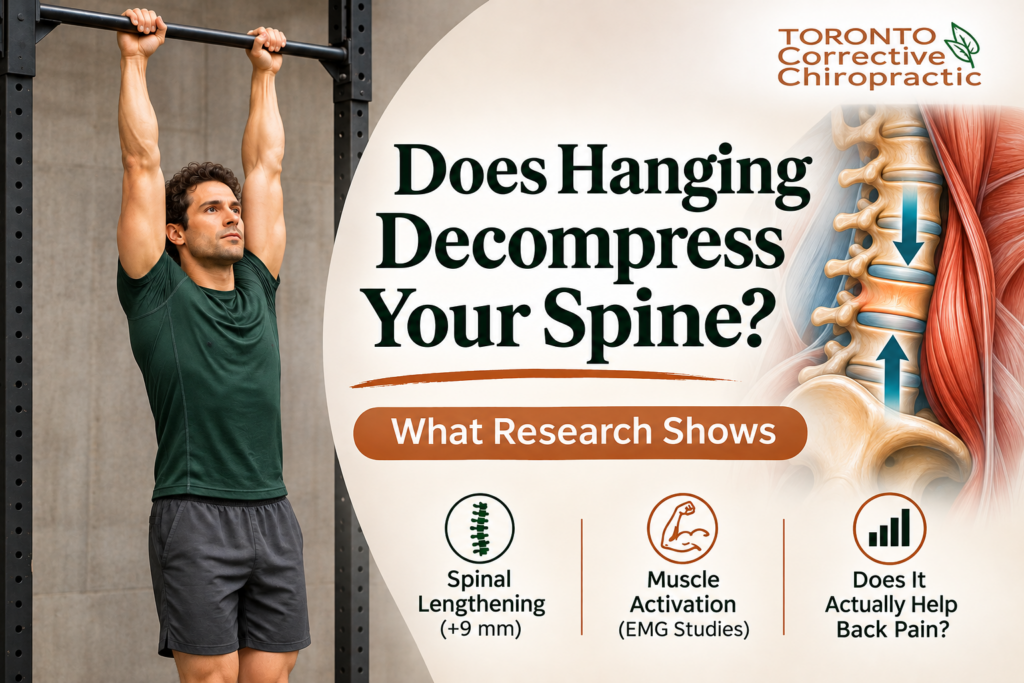
But does a dead hang actually decompress your spine? Which muscles are working while you’re hanging? And, most importantly, is there evidence that dead hangs help people with low back pain?
The research suggests that hanging can temporarily lengthen the spine. However, that doesn’t necessarily mean it reduces pressure inside spinal discs or provides lasting pain relief.
There is also an interesting biomechanical complication: muscle contractions can create substantial internal forces through the spine, even while the body is suspended.
Let’s examine four questions: the potential benefits of dead hangs, what happens biomechanically, which muscles are active, and whether the exercise actually works for back pain. By the end you will know know true/false: does hanging decompress your spine?
1. Do Dead Hangs Actually Lengthen or Decompress the Spine?
There is direct research examining this question, although the studies are relatively small and limited.
The 2018 Gravity Traction Study: Approximately 9 mm of Lengthening
A study presented at the 2018 International Meeting of the Society on Scoliosis Orthopaedic and Rehabilitation Treatment examined 32 young adults in three positions:
- Standing normally.
- Hanging from a pull-up bar with the arms overhead.
- Suspended using parallel bars with the arms alongside the body.

Researchers used surface-topography imaging to estimate changes in spinal geometry and trunk length.
They reported average increases in trunk length of:
9.31 mm during pull-up-bar suspension and 20.86 mm during parallel-bar suspension.
These changes were statistically significant.
This is important because it provides objective evidence that suspension can produce measurable changes in trunk length.
However, there are several limitations.
First, this was a conference abstract rather than a full clinical trial with detailed published methodology.
Second, trunk lengthening isn’t the same as directly measuring intervertebral disc pressure.
Third, the researchers weren’t studying people with low back pain or evaluating whether hanging improved symptoms.
Finally, we don’t know how long the changes persisted after suspension.
The study supports the idea that gravity can temporarily lengthen the trunk, but it doesn’t establish that dead hangs are an effective treatment for spinal disc problems.
The 1985 Radiographic Study: Not Everyone’s Spine Responds the Same Way
An earlier study by Théry and colleagues examined 100 healthy adult men using radiographs of the lumbar spine in standing and suspended positions.
The findings were particularly interesting:
- 70% demonstrated lumbar spinal lengthening.
- 22% demonstrated shortening.
- 8% primarily demonstrated straightening.
The authors concluded that the lumbar response to suspension was influenced by tonic muscular activity and individual anatomy.
This is a valuable finding because it challenges the assumption that gravity affects everyone’s lumbar spine identically.
Some individuals lengthened, while others demonstrated different changes in spinal geometry.
Clinical interpretation: Suspension can change spinal dimensions, but the effect is variable and doesn’t establish that every person experiences meaningful disc decompression. Does hanging decompress the spine: so far we are not there yet with an answer!
2. What Happens Biomechanically During a Dead Hang? | Does Hanging Decompress The Spine
When you hang from a pull-up bar, your body weight creates a downward gravitational force while your arms and shoulders support your body from above.
This can produce a traction effect through portions of the spine.
However, the spine isn’t simply a passive chain of bones and discs.
Muscles generate forces across spinal segments, and those forces can change the mechanical response to hanging.
External Traction vs. Internal Compression
These two forces can exist simultaneously.
External traction refers to the pulling force created by gravity acting on the suspended body.
Internal compression can arise from muscle contractions that generate forces across the spinal joints and discs.
Whether a particular spinal segment experiences net distraction, compression, bending or shear depends on the combination of forces, body position and muscular activity.
Consequently, simply observing that someone is hanging doesn’t tell us the actual pressure inside their lumbar discs.
The McGill Research: Hanging Exercises Can Generate Substantial Spinal Loading
Research by Stuart McGill and colleagues at the University of Waterloo examined spinal loading during pulling exercises, including pull-ups and chin-ups.
The researchers recorded muscle activity, external forces and three-dimensional movement, then used biomechanical modelling to estimate internal spinal loads.
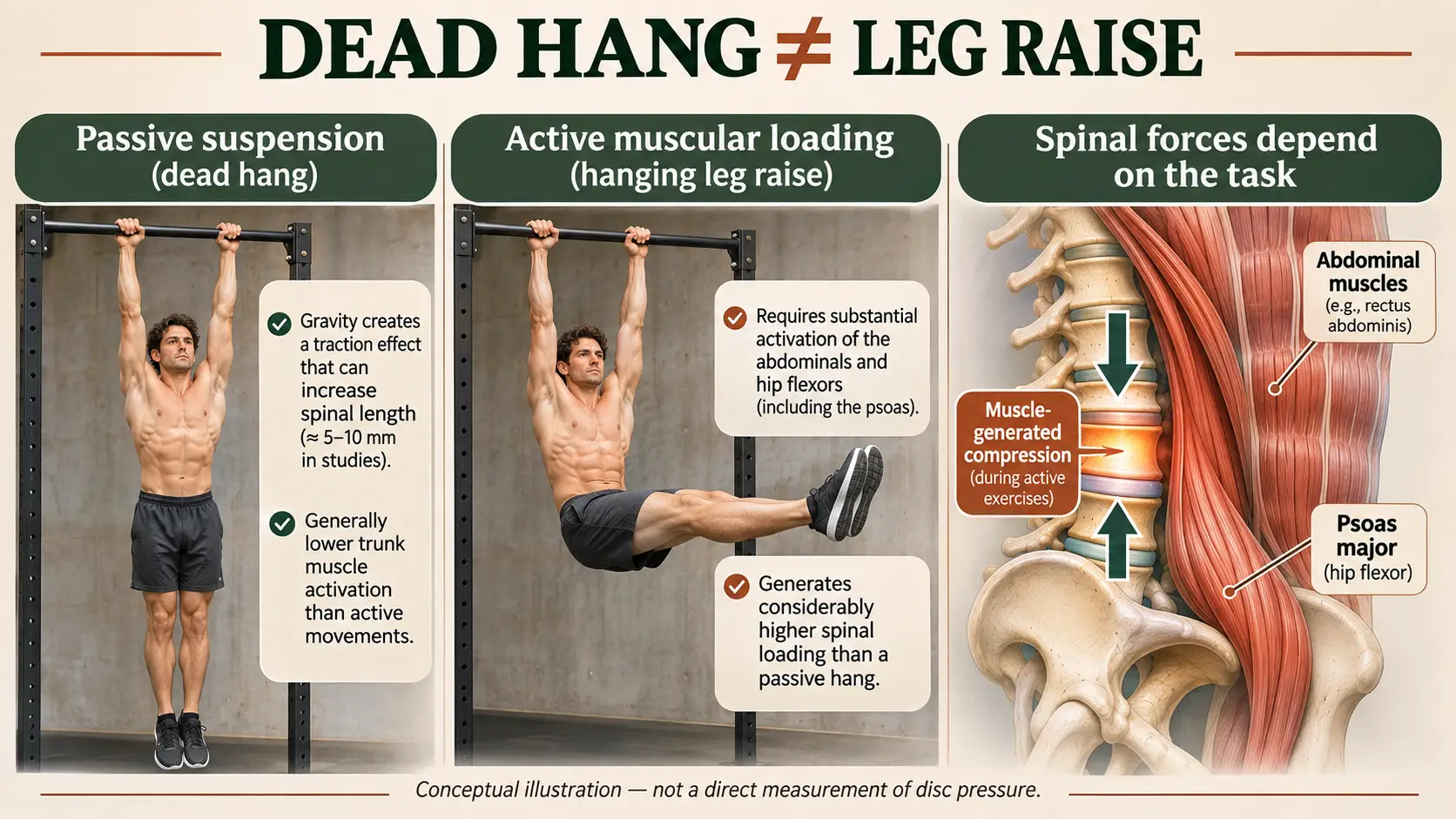
They found that pull-ups and chin-ups generated substantial spinal loading because of the muscular demands of the exercises, despite the body being suspended.
Interestingly, coaching shoulder retraction also increased estimated spinal loading.
A related study examined hanging leg raises, the body saw and walkouts from a push-up position.
The hanging leg raise required considerable muscular recruitment and generated substantial estimated spinal compression.
These findings demonstrate an important principle:
Hanging from a bar doesn’t automatically mean the spine is mechanically unloaded.
But there’s a critical distinction.
A passive dead hang requires much less trunk and hip-flexor activity than an active hanging leg raise or pull-up.
We cannot use spinal compression estimates from those demanding exercises to calculate the forces occurring during a relaxed dead hang.
The studies demonstrate the importance of muscular forces, not that passive hanging is inherently compressive or harmful.
3. Which Muscles Are Active During a Dead Hang? Does Hanging Decompress The Spine
One of the most useful recent studies was published in 2026 and examined muscular coordination during sustained dead hangs in climbers.
Eleven experienced male climbers performed a sustained hang from a 20 mm wooden edge until fatigue.
Researchers used electromyography (EMG) and motion analysis to study upper-body muscular coordination.
They recorded activity from six muscle groups:
- Finger flexors.
- Finger extensors.
- Brachioradialis.
- Biceps brachii.
- Trapezius.
- Pectoralis major.
The researchers found that fatigue changed how these muscles coordinated, with increased synchronization among several forearm, arm and shoulder muscle pairs.
This suggests that sustained hanging involves an active, coordinated muscular strategy rather than complete muscular relaxation.
However, this study used a climbing-specific hangboard rather than an ordinary pull-up bar.
It also didn’t directly measure the psoas, abdominal muscles, lumbar extensors or spinal disc pressure.
What About the Psoas?
The psoas major is an important hip flexor that attaches to the lumbar vertebrae.
Because of those attachments, psoas contraction can generate compressive, bending and shear forces through the lumbar spine.
During active hanging leg raises, hip-flexor recruitment becomes particularly relevant because the legs must be lifted against gravity.
However, we should distinguish that from a relaxed dead hang.
There is insufficient direct evidence demonstrating how much psoas activity occurs during ordinary passive hanging or whether that activity meaningfully counteracts lumbar traction.
This is an important distinction because some online explanations imply that any activation of the psoas automatically makes hanging harmful.
The available research doesn’t support such a definitive conclusion.
4. Do Dead Hangs Actually Help Low Back Pain?
This is where the evidence becomes considerably weaker.
Although there are studies examining spinal geometry during suspension, high-quality clinical research specifically evaluating ordinary dead hangs as a treatment for low back pain is lacking.
To understand whether the underlying concept is useful, we can look at the broader literature on spinal traction.
What Does the Research on Spinal Traction Show?
A major Cochrane systematic review examined 32 randomized controlled trials involving 2,762 participants with low back pain, with or without sciatica.
Overall, the authors concluded that traction generally provided little or no clinically meaningful improvement in pain, function or global recovery.
A later systematic review examining different traction methods suggested possible short-term pain improvements in some people with lumbar radiculopathy, although the evidence was of low or very low certainty.
More recently, the World Health Organization recommended against routine traction for chronic primary low back pain.
These findings don’t mean that no individual can experience relief.
They do mean that spinal traction has not consistently demonstrated substantial long-term clinical benefits across broad low back pain populations.
And importantly, clinical traction studies cannot automatically be applied to dead hangs.
The direction of force, amount of traction, muscular activity, body positioning and duration may all differ.
Does Hanging Reverse Disc Herniations?
There is no convincing evidence that ordinary dead hangs reliably reverse lumbar disc herniations.
Some disc herniations regress naturally over time, and many patients improve with appropriate conservative management.
But a temporary stretching sensation shouldn’t be interpreted as proof that a herniated disc has been pulled back into place.
5. Why Might Hanging Still Feel Good? Does Hanging Decompress Your Spine
Despite the limitations of the research, some people genuinely find hanging comfortable.
There are several plausible explanations.
Temporary Changes in Spinal Loading
Hanging may briefly change the forces acting on spinal joints and surrounding tissues.
Stretching the Lats and Posterior Trunk
The overhead position can stretch the latissimus dorsi and other tissues around the shoulders and trunk.
The latissimus dorsi connects through the thoracolumbar fascia, contributing to force transmission between the upper body, trunk and pelvis.
Changing Position
Moving away from prolonged sitting, standing or another sustained posture can sometimes reduce discomfort.
Changes in Pain Sensitivity
Stretching and movement can temporarily change how the nervous system processes discomfort.
None of these effects is inherently undesirable.
Temporary relief can be valuable, even when it doesn’t represent permanent structural correction.
The problem arises when temporary relief is presented as proof that the underlying cause of back pain has been fixed.
6. Could Dead Hangs Make Back Pain Worse?
Potentially, although there isn’t strong direct research identifying which low back pain patients are most likely to worsen during dead hangs.
Some people may find suspension uncomfortable because of their spinal position, sensitivity to traction or muscular bracing.
Others may be limited primarily by their shoulders, elbows, wrists or grip.
A dead hang also places substantial demands on the upper limbs, making it inappropriate for some people with shoulder instability or certain upper-extremity injuries.
The presence of spinal compression during active exercises doesn’t automatically mean those exercises are harmful.
Compression is a normal component of physical activity.
The relevant clinical question is whether the exercise is appropriate for the person’s symptoms, capacity and goals.
7. My Alternative: A Supported Doorknob Stretch
One alternative I often demonstrate is a supported doorknob stretch.
Unlike a full dead hang, this movement allows you to keep your feet on the floor and control how much tension you apply.
It can be adapted to emphasize different regions.
Variation 1: Posterior Chain and Lower Back
By adjusting your hip position and rotating through the trunk, you can bias the stretch toward the posterior trunk and thoracolumbar tissues.
Variation 2: Shoulder and Latissimus Dorsi
By changing your position and focusing on the shoulder, you can emphasize the latissimus dorsi and posterior shoulder.
The advantage is that the stretch is adjustable and doesn’t require you to suspend your entire body weight.
However, this stretch hasn’t been proven to decompress spinal discs or to be clinically superior to hanging.
It’s simply another option for people who want a controlled stretching movement.
Watch my doorknob stretch demonstration:
Use a secure, stationary support and avoid forcing the stretch. Stop if it increases pain or neurological symptoms.
8. So, Should You Hang From a Bar?
If hanging feels comfortable, your shoulders tolerate it and you enjoy the movement, there’s no reason to automatically avoid it.
It may provide a pleasant stretch, challenge your grip and shoulder musculature, and temporarily change spinal loading.
But I wouldn’t recommend it as a proven treatment for lumbar disc herniations or chronic low back pain.
And I wouldn’t interpret the sensation of decompression as proof that a spinal disc has been mechanically corrected.
9. Why Does Your Back Keep Feeling Like It Needs Decompression?
This is the question I find most important clinically.
If you continually need to hang, stretch or crack your back to feel comfortable, why does the discomfort keep returning?
Recurring back pain can involve multiple contributors:
- Sensitivity involving spinal joints, discs or surrounding tissues.
- Reduced tolerance for certain postures or physical loads.
- Changes in movement capacity, strength or mobility.
- Inadequate recovery or excessive repetitive loading.
- Persistent pain sensitivity following an earlier injury.
At Toronto Corrective Chiropractic, we distinguish between the Core Problem and the Collateral Damage.
The area that feels tight or painful isn’t always the only factor contributing to the symptoms.
Our goal is to identify the relevant mechanical, neurological and functional contributors rather than relying exclusively on temporary symptom relief.
Does Hanging Decompress Your Spine? What is the bottom line?
The research supports several conclusions.
First, hanging can produce measurable changes in spinal length and geometry.
Second, the lumbar response varies between individuals and is influenced by muscular activity.
Third, upper-body muscles remain active during sustained dead hangs, while more demanding hanging exercises can generate substantial internal spinal loads.
Fourth, there is insufficient direct evidence that ordinary dead hangs provide lasting improvements in low back pain or reliably decompress herniated discs.
If hanging feels good, it may be a useful movement.
If it doesn’t, a supported stretch such as the doorknob variation may be a more comfortable alternative.
But if your back pain keeps returning, the most important question isn’t necessarily how to decompress your spine again.
It’s why your back keeps becoming uncomfortable in the first place.
Frequently Asked Questions | Does Hanging Decompress Your Spine
Do dead hangs decompress your lumbar discs?
Dead hangs can produce temporary spinal lengthening, but direct evidence demonstrating reduced intradiscal pressure during ordinary hanging is limited.
How much does your spine lengthen during a dead hang?
A 2018 conference study reported an average trunk-length increase of approximately 9.3 mm during pull-up-bar suspension. This should not be interpreted as 9.3 mm of disc separation.
Which muscles work during dead hangs?
Research in climbers identifies coordinated activity involving the finger flexors and extensors, brachioradialis, biceps, trapezius and pectoralis major. The degree of lumbar and psoas activation during passive bar hangs remains inadequately studied.
Are hanging leg raises bad for your spine?
Not inherently. They generate substantial muscular forces and estimated spinal loading, but loading alone doesn’t establish injury or harm.
Can dead hangs fix sciatica?
There is insufficient direct evidence to recommend dead hangs as a proven treatment for sciatica. Persistent or progressive radiating symptoms warrant appropriate clinical assessment.
Struggling With Recurring Low Back Pain in Toronto?
At Toronto Corrective Chiropractic, we assess the spine, nervous system and movement patterns to help identify the factors contributing to persistent or recurring back pain.
Learn more or book an assessment at https://dralexritza.com/.
Research References
- Knott P, Beck D, Streeter J, Vogt E. Evaluating and Standardizing Traction X-Ray Methods Using Surface Topography. SOSORT 2018 conference abstract.
- Théry Y, et al. Anatomical and roentgenological basis for the study of the lumbar spine with the body in the suspended position. Anatomia Clinica. 1985.
- McGill SM, Cannon J, Andersen J. Muscle activity and spine load during pulling exercises. Journal of Electromyography and Kinesiology. 2014.
- McGill SM, Andersen J, Cannon J. Muscle activity and spine load during anterior chain whole body linkage exercises. Journal of Sports Sciences. 2015.
- Upper-Body Neuromechanical Coordination Strategies During Fatiguing Sustained Dead Hangs in Climbers. European Journal of Sport Science. 2026.
- Wegner I, et al. Traction for low-back pain with or without sciatica. Cochrane Database of Systematic Reviews. 2013.
- World Health Organization. WHO guideline for non-surgical management of chronic primary low back pain in adults. 2023.