Why Does My Back Hurt More in the Morning? 5 Common Causes
Wondering ” Why does my back hurt more in the morning “? Do you wake up with a stiff, sore lower back that takes a few minutes to loosen up. Or maybe it takes hours and exercises and getting out of bed is the hardest part of your day

But, once you’re moving, your back feels considerably better.
Morning back pain is a common complaint we see at Toronto Corrective Chiropractic. What’s interesting is that the underlying causes can be quite different. Even hearing a patient say 5 minutes vs. 60 minutes to loosen up paints a vastly different picture!
Sometimes it’s related to your mattress or sleeping position. Other times, it may involve changes in spinal loading overnight, muscle soreness from the previous day, or an inflammatory condition.
At our clinic, we always try to get to the Core Problem behind health issues and understanding the mechanism of strain is so important – read more about Our Process here
Five Possible Explanations for Morning Back Pain
The five Possible Explanations for Why Does My Back Hurt More In The Morning range from posture, to pets, to serious inflammatory conditions or that sport you did yesterday!
1. Inflammatory Morning Back Pain
One of the most important distinctions we make when assessing morning back pain is whether symptoms suggest a mechanical or inflammatory problem.
Inflammatory back pain is associated with conditions such as axial spondyloarthritis – an autoimmune condition.
Typical features include:
- Morning stiffness lasting more than 30 minutes
- Pain that improves with exercise but not necessarily with rest
- Symptoms that wake you during the second half of the night
- Gradual onset, often before age 45
- Alternating buttock pain in some individuals
These findings don’t automatically mean someone has inflammatory arthritis. However, a combination of these features should prompt further assessment with a physician that includes bloodwork for inflammatory markers and potentially imaging.
This is especially relevant if symptoms have persisted for months or there’s a history of psoriasis, inflammatory bowel disease, or recurrent eye inflammation.
If this is why your back hurts more in the morning it is less amenable to chiropractic care than mechanical/traditional back pain.
2. Overnight Disc Hydration and Spinal Stiffness | Morning Back Pain
Your spine actually changes slightly while you sleep. Why your back hurts more in the morning could be because of spinal swelling at night!
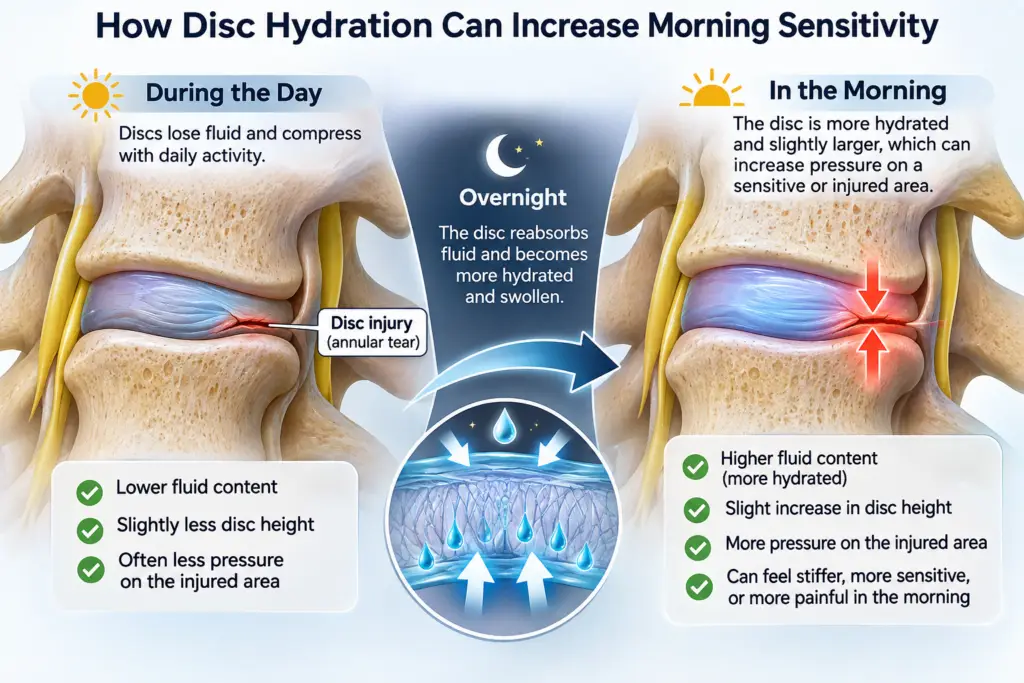 Throughout the day, spinal discs experience compression from standing, walking, sitting, and other activities. Overnight, when these loads are reduced, the discs reabsorb fluid and regain some of their height.
This is one reason you’re typically slightly taller in the morning than in the evening.
The discs are also generally more hydrated after sleeping, which can change their mechanical behaviour.
For someone with a sensitive lumbar spine, bending forward or lifting first thing in the morning may feel different than performing the same movement later in the day.
Spinal joints and surrounding tissues may also feel stiff following prolonged inactivity, although this shouldn’t be attributed to a simple joint-hydration mechanism.
Practical advice: If your back is particularly sensitive first thing in the morning, try some gentle walking and comfortable movement (Cat-Camels) before demanding bending or heavy lifting.
3. Your Mattress May Be Part of the Problem | Why Does My Back Hurt More In The Morning
This is something people frequently overlook why their back hurts more in the morning

A mattress doesn’t have to be extremely old to stop providing comfortable support.
Ask yourself:
- Does your back feel better when you sleep at a hotel, your parents’ house, or somewhere else?
- Is there a noticeable divot or sag where you usually sleep?
- Do you feel like your hips or pelvis are sinking into the mattress?
- Do you consistently wake up sore, only to feel better after getting out of bed?
If you answered yes to several of these questions, your mattress may be contributing to the problem.
A useful clue is whether your morning symptoms consistently improve when sleeping on a different mattress.
Research suggests that medium-firm mattresses may be more comfortable than very firm mattresses for some people with chronic nonspecific lower back pain. However, there is no universally ideal mattress.
If your mattress has significant sagging, feels unsupportive, and your symptoms reliably improve elsewhere, replacement may be worth considering.
4. Delayed-Onset Muscle Soreness or Strain
Sometimes the explanation for morning back pain is something you did yesterday — or even two days ago.
Delayed-onset muscle soreness, commonly called DOMS, typically develops after unfamiliar or strenuous exercise.
Symptoms often begin 12–24 hours after activity and can peak approximately 24–72 hours later.
Examples include:
- Returning to the gym after time off
- Heavy lifting or deadlifts
- Gardening or yard work
- Moving furniture
- A particularly demanding cycling or running session
DOMS usually involves diffuse muscular tenderness and stiffness that gradually resolves.
A muscle strain, on the other hand, may produce more localized pain associated with a particular movement or injury.
If your back is sore following an unusual physical effort, consider whether you’re experiencing temporary muscular soreness rather than a recurring spinal problem.
5. Sleeping Position, Pets, and Kids

Sometimes your mattress is perfectly fine, but you’re not actually sleeping comfortably on it.
If you share your bed with a dog, cat, or young child, you may find yourself sleeping twisted to one side, confined to a small space, or unable to change positions comfortably.
Sustained positions can aggravate an already sensitive back.
You might have a perfectly good $3,000 mattress, but if your dog takes up half of it and you’re sleeping like a pretzel, the mattress probably isn’t the problem.
There’s no single sleeping position that’s ideal for everyone.
Instead, consider whether you have enough space, whether your position feels comfortable, and whether you can move naturally during the night.
Before buying a new mattress, it may be worth experimenting with your sleeping arrangement.
When Should You Be Concerned About Morning Back Pain?
Morning stiffness that improves quickly with movement is not necessarily a sign of a serious condition.
However, persistent or progressively worsening pain, prolonged morning stiffness, significant night pain, or symptoms accompanied by neurological changes deserve further evaluation.
Urgent assessment is warranted for new bladder or bowel dysfunction, saddle numbness, or significant progressive leg weakness.
Fever, unexplained weight loss, or a history of cancer alongside new back pain should also prompt timely medical evaluation.
Finding the Core Problem Of Morning Back Pain
At Toronto Corrective Chiropractic, our approach is to understand why your back hurts rather than simply treating the area that feels uncomfortable.
Morning back pain can involve mechanical, inflammatory, muscular, or environmental contributors — and the most appropriate treatment depends on identifying which factors are relevant to you.
We Find the Core Problem.
If you’re experiencing persistent morning back pain, contact Toronto Corrective Chiropractic to arrange an assessment.
Frequently Asked Questions About Morning Back Pain
Why does my back hurt when I wake up but improve after walking?
Gentle movement may reduce stiffness and improve comfort after prolonged inactivity. However, improvement with movement can also occur with inflammatory back pain, so the overall symptom pattern matters.
Can an old mattress cause lower back pain?
An uncomfortable or sagging mattress may contribute to symptoms in some individuals. Consistent improvement when sleeping elsewhere can be a useful clue.
Is morning back stiffness a sign of arthritis?
Not necessarily. However, prolonged stiffness accompanied by inflammatory features may warrant investigation for conditions such as axial spondyloarthritis.
What is the best sleeping position for lower back pain?
There isn’t one universally best position. Choose a comfortable position that doesn’t consistently aggravate symptoms, and ensure you have enough room to move.