
Headache at the Base of Your Skull and Behind One Eye: Could It Be Coming From Your Neck?
Headache at Base of Skull By Dr. Alex Ritza | Toronto Corrective Chiropractic | Toronto, Ontario
A headache that begins at the base of your skull and travels toward or behind one eye can sometimes originate from structures in your upper neck. This pattern may occur with cervicogenic headache, but migraine, occipital neuralgia, and other conditions can produce overlapping symptoms. The location of your headache alone cannot establish its cause or how to fix them.

Understanding the differences is important because the appropriate treatment depends on identifying the underlying problem.
What Is a Cervicogenic Headache? Headache At The Base of The Skull
A cervicogenic headache is a secondary headache attributed to a disorder or lesion involving structures in the cervical spine.
Unlike a primary headache disorder, such as migraine, the source of the pain is considered to be in the neck, even though the pain may be experienced elsewhere in the head.
Symptoms may include:
- Headache predominantly affecting one side of the head
- Pain beginning in the upper neck or base of the skull
- Pain extending toward the temple, forehead, or eye
- Restricted cervical range of motion
- Headache aggravated by particular neck movements or sustained positions
However, these features are not exclusive to cervicogenic headache. Neck pain and tenderness are also common in people with migraine.

A cervicogenic headache diagnosis requires more than finding a stiff or tender neck. There should be evidence supporting a causal relationship between a cervical disorder and the headache.
Why Can a Problem in Your Neck Cause Pain Behind Your Eye?
The explanation involves the trigeminocervical complex, where sensory information from the upper cervical region converges with pathways carrying sensation from the head and face.
Sensory input from upper cervical structures, particularly those associated with C1–C3, can therefore contribute to pain perceived in regions supplied by the trigeminal system.
This phenomenon is known as referred pain.
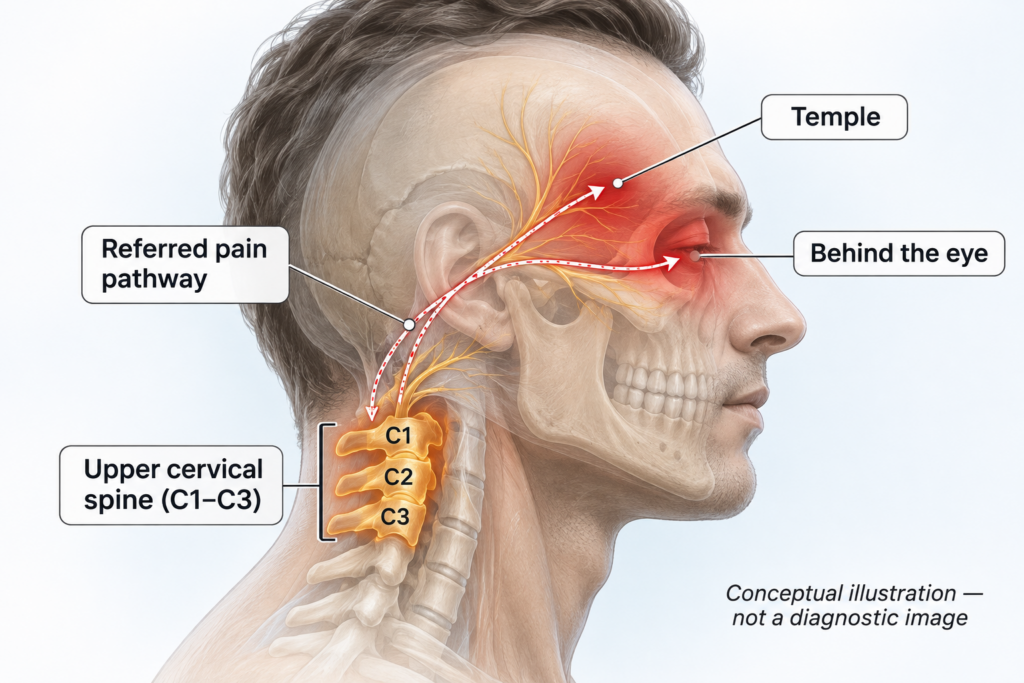
It helps explain why a person can experience discomfort around the forehead or eye even when the contributing pain source is located in the upper cervical region.
However, this neurological connection does not mean that pain behind the eye is necessarily caused by a neck problem.
Cervicogenic Headache vs. Migraine vs. Occipital Neuralgia
Several conditions can produce similar pain patterns.
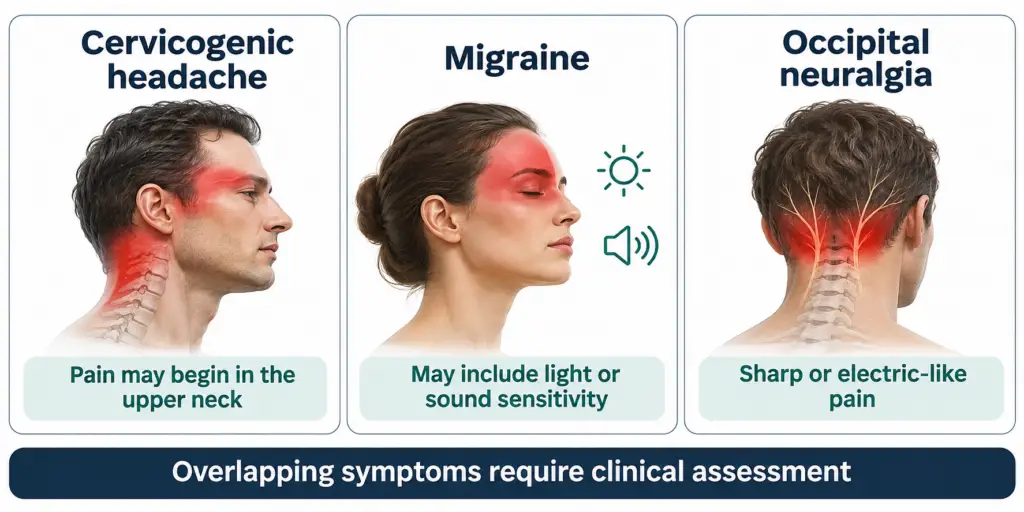
1. Cervicogenic headache
Cervicogenic headache may be suspected when a headache is consistently associated with cervical movement, restricted neck mobility, or a demonstrated cervical disorder.
Evidence that headache symptoms improve alongside resolution of the cervical disorder can further support the diagnosis.
2. Migraine
Migraine can cause unilateral headaches, pain around the eye, nausea, sensitivity to light or sound, and aggravation with routine activity.
Importantly, migraine can also cause neck pain and stiffness.
The presence of neck discomfort should not automatically lead to a diagnosis of cervicogenic headache.
3. Occipital neuralgia
Occipital neuralgia typically involves recurrent shooting, stabbing, or electric-like pain in the distribution of the occipital nerves.
Scalp sensitivity or tenderness may also be present.
Occipital neuralgia can occasionally produce pain extending toward the front of the head or orbital region through shared neurological pathways.
These conditions require different diagnostic considerations, and some patients may have more than one headache disorder.
Does Turning Your Neck Make Your Headache Worse? | Headache At The Base of The Skull
Headache provoked by cervical movement can be a useful clinical clue, particularly when it is reproducible and accompanied by restricted neck mobility.
But it is not diagnostic on its own.
For example, someone with migraine may also find neck movement uncomfortable during an attack.
A clinician must consider the full headache history, neurological findings, cervical examination, and any indications that medical investigation is necessary.
How We Assess Headaches at Toronto Corrective Chiropractic
At Toronto Corrective Chiropractic, our focus is on determining whether cervical dysfunction is a meaningful contributor to a patient’s symptoms rather than assuming that every headache is spinal in origin.
An assessment may include:
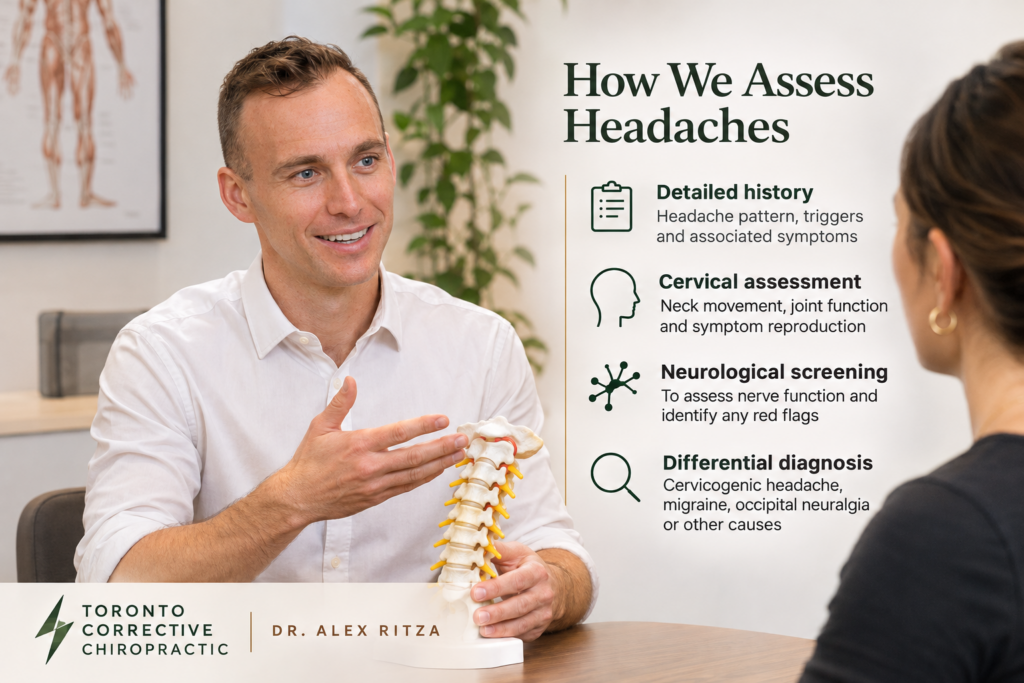
1. Detailed headache history
We examine the location, frequency, duration, character, associated symptoms, and aggravating or relieving factors.
2. Cervical movement assessment
We evaluate cervical range of motion, movement sensitivity, and whether specific movements reproduce familiar symptoms.
3. Neurological screening
Where clinically indicated, we assess neurological function and screen for findings that require medical referral.
4. Assessment of cervical and related musculoskeletal function
We examine relevant movement restrictions, joint function, and muscular findings, interpreting these within the broader clinical presentation.
5. Differential diagnosis
We consider whether the symptoms are more consistent with cervicogenic headache, migraine, occipital neuralgia, or another condition.
Our goal is to identify the most plausible underlying problem and determine whether conservative care is appropriate.
Can Chiropractic Treatment Help Cervicogenic Headaches? | Headache At The Base of The Skull
For appropriately selected patients, conservative management may include cervical exercise, manual therapy, and strategies to improve neck function and activity tolerance.
Some clinical evidence supports manual therapy and exercise for reducing symptoms in people with cervicogenic headache, although study quality and treatment effects vary.
Treatment should be individualized, and a response to treatment does not by itself prove that a particular spinal structure caused the headache.
When symptoms suggest migraine, another primary headache disorder, or a condition outside the scope of conservative musculoskeletal care, appropriate medical evaluation or collaborative management may be necessary.
When Should a Headache Be Medically Evaluated?
A new or unusual headache should not automatically be attributed to the neck.
Seek emergency assessment for a sudden, extremely severe headache, or a headache accompanied by new neurological deficits, significant visual changes, confusion, or other acute concerning symptoms.
Prompt medical evaluation is also important for headaches associated with fever and neck stiffness, recent significant trauma, or a new or progressively worsening pattern.
Frequently Asked Questions
Can neck problems cause pain behind one eye?
Yes. Pain arising from upper cervical structures can sometimes be referred toward the forehead or orbital region. However, migraine and other conditions can produce similar symptoms.
Is a headache at the base of my skull always cervicogenic?
No. Migraine, tension-type headache, occipital neuralgia, and other conditions may involve pain in this region.
Can poor posture cause cervicogenic headaches?
Sustained positions may aggravate symptoms in some individuals, but posture alone is not sufficient to establish the cause of a headache.
How can I tell whether my headache is coming from my neck?
A detailed history and clinical assessment are necessary. Restricted cervical movement and reproducible headache provocation may provide supporting evidence, but no single symptom confirms the diagnosis.
Should I see a chiropractor or physician for recurring headaches?
That depends on the presentation. A clinician experienced in headache assessment can help identify potential cervical contributions, while headaches with concerning features or suspected primary neurological causes may require medical evaluation.
Looking for a Headache Assessment in Toronto?
If you experience recurring headaches associated with neck pain, restricted cervical movement, or pain extending from the base of your skull toward your eye, a detailed assessment may help clarify the possible causes.
At Toronto Corrective Chiropractic, near Bloor and Yonge in downtown Toronto, our approach focuses on identifying the underlying clinical problem and determining an appropriate management plan.
Book an assessment with Dr. Alex Ritza at Toronto Corrective Chiropractic.
This article is educational and does not replace individualized medical assessment.