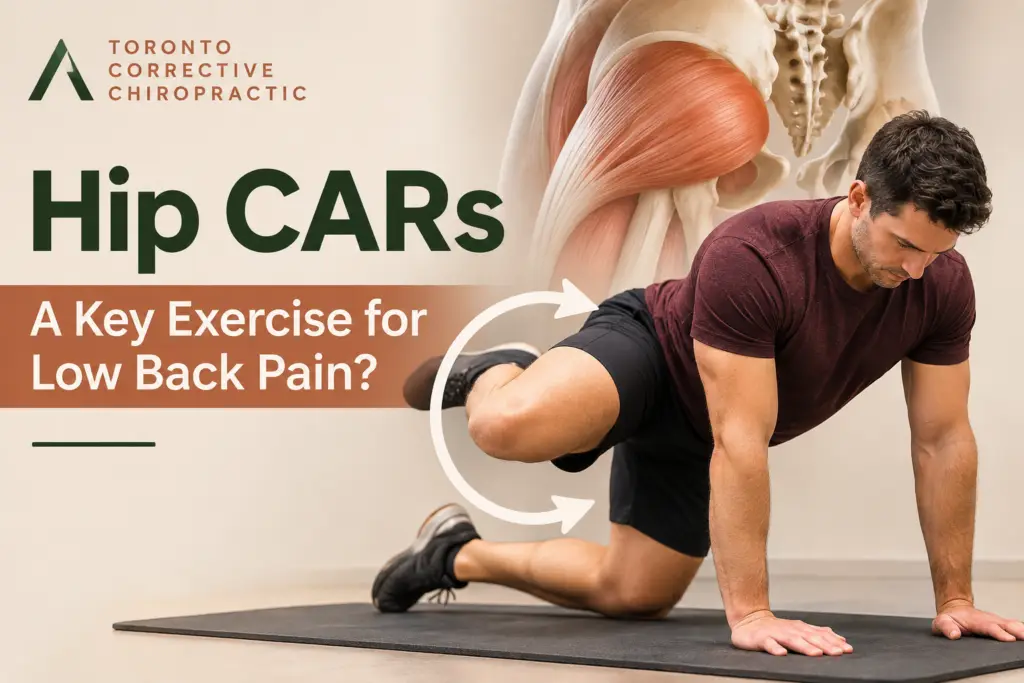
Hip CARs: Improve Hip Mobility and Glute Function to Reduce Low Back Pain
If you regularly experience low back pain after exercise, working out, or prolonged physical activity, the problem may not be coming entirely from your lower back. Improving hip mobility for low back pain may be the key!
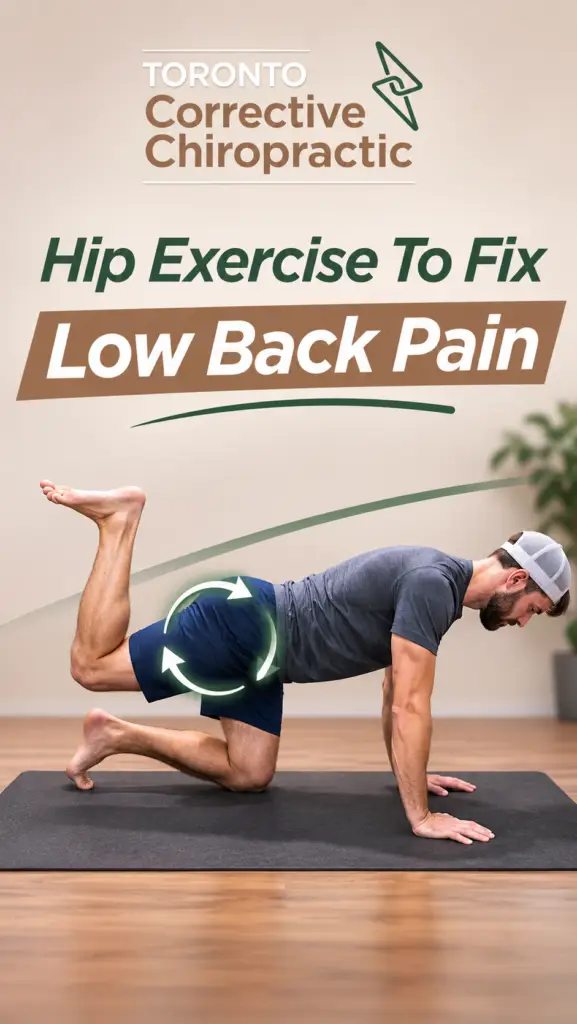
In many patients we examine at Toronto Corrective Chiropractic, poor hip mobility, inadequate gluteal strength, or difficulty controlling movement through the hips can contribute to excessive loading of the lumbar spine.
One of our goals with corrective chiropractic care is to identify why the lower back is being overloaded in the first place.
Sometimes, that means improving the way your hips and glutes work.
One of my favourite exercises for developing better hip control is the Hip CAR (Controlled Articular Rotation), also commonly called a hip circle.
Why Your Hips and Glutes Matter for Low Back Pain
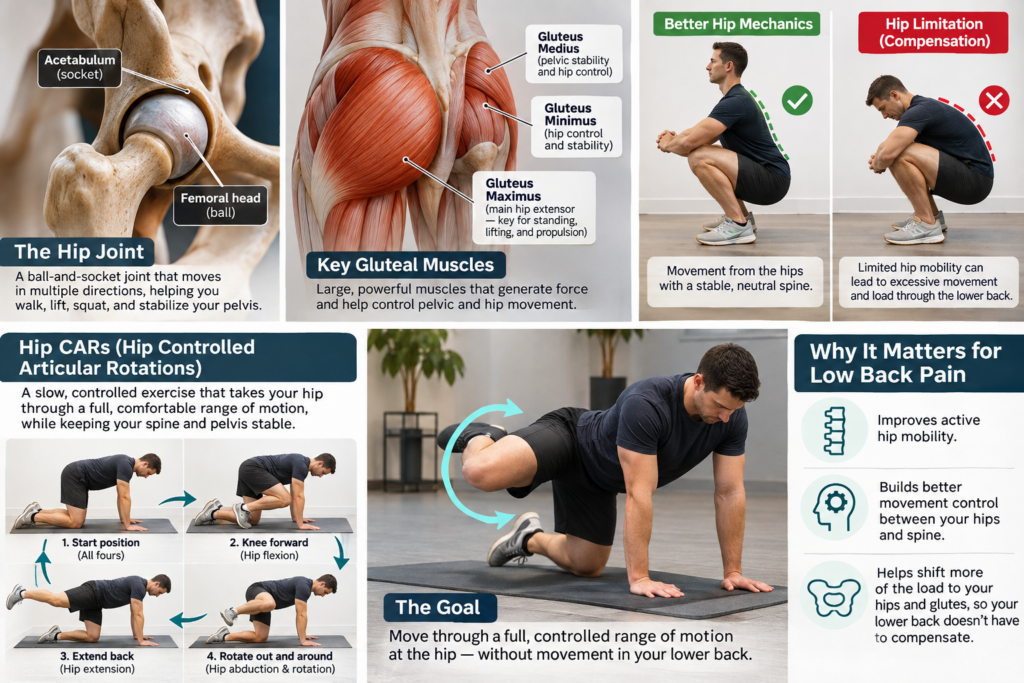
Your hips contain some of the largest and strongest muscles in your body, including the gluteus maximus, gluteus medius, and gluteus minimus.
These muscles are essential for walking, running, cycling, squatting, lifting, and stabilizing the pelvis.
Your lumbar spine also contains powerful muscles, including the erector spinae and multifidus, which help support, stabilize, and move your spine.
The problem isn’t that your lower back muscles are working. They’re supposed to.
The problem can arise when your lower back repeatedly compensates for movement or force that could be better managed through your hips.
For example:
- During a squat, limited hip mobility may cause you to compensate with excessive lumbar flexion.
- During a deadlift, inadequate hip extension or poor hip-hinge control may increase the demand on your lower back.
- During running or other single-leg activities, poor gluteal control can contribute to altered pelvic and trunk mechanics.
- During everyday bending and lifting, difficulty coordinating hip and spinal movement may place unnecessary stress on sensitive lumbar structures.
These compensations don’t automatically cause pain. However, in someone with an already irritated or overloaded lower back, they can become important contributing factors.

The Connection Between Glute Weakness and Low Back Pain
The gluteal muscles are particularly important because of their role in generating force and controlling the pelvis.
The gluteus maximus is a major hip extensor, helping you stand up, climb stairs, accelerate, and lift objects.
The gluteus medius and minimus contribute to pelvic stability and hip control, particularly when standing or moving on one leg.
When these muscles are weak, poorly coordinated, or not being used effectively during a particular movement, other muscles may take on additional work.
 This can include muscles surrounding the lumbar spine.
Research has identified associations between low back pain and altered hip strength, mobility, and muscle activation. However, these relationships vary between individuals, and glute weakness is not necessarily the cause of every low back complaint.
That’s why simply strengthening your glutes isn’t always enough.
We also need to improve how your nervous system coordinates movement between your hips, pelvis, and spine.
What Are Hip CARs? | Hip Mobility For Low Back Pain
Hip CARs stands for Hip Controlled Articular Rotations.
They’re a slow, deliberate exercise that takes your hip joint through a large, comfortable range of motion while minimizing unwanted movement elsewhere in your body.
Unlike traditional stretching, which often emphasizes flexibility, Hip CARs focus on actively controlling your available range of motion.
The exercise challenges your ability to move your femur within the acetabulum — the ball-and-socket joint of your hip — without relying excessively on movement through your lower back or pelvis.
This makes Hip CARs particularly useful for patients who struggle to distinguish hip movement from lumbar spine movement.
Why I Recommend Hip CARs for Some Patients With Low Back Pain
There are three main reasons I like this exercise:
1. Improving active hip mobility
Hip CARs encourage controlled movement through hip flexion, abduction, extension, and rotation.
Rather than simply stretching a tight muscle, you’re actively using the muscles surrounding the joint throughout the movement.
2. Improving motor control
Many people can move their hips through a reasonable range of motion but struggle to do so without moving their lower back.
Hip CARs help you practise controlling the hip independently of the lumbar spine.
This is particularly relevant for patients whose lower back repeatedly compensates during exercise.
3. Developing better hip and pelvic coordination
By improving awareness and control of hip movement, we can work toward more efficient movement patterns during activities such as squatting, lifting, running, and other exercises.
Hip CARs are not a substitute for glute strengthening, but they can complement exercises such as glute bridges, fire hydrants, and hip hinges.
How to Perform Quadruped Hip CARs
For most beginners, I recommend starting on all fours rather than standing.
The quadruped position makes it easier to stabilize your trunk and concentrate on moving the hip.
Step 1: Set your position
Start on your hands and knees, with your hands beneath your shoulders and knees beneath your hips.
Gently brace your abdominal muscles to maintain a relatively neutral spine.
Step 2: Bring your knee forward
Keeping your knee bent approximately 90 degrees, slowly bring one knee forward toward your chest.
Avoid rounding your lower back to gain additional movement.
Step 3: Rotate the hip outward
Move your knee out to the side, similar to a fire hydrant exercise.
Continue rotating the hip while keeping your pelvis as stable as possible.
Step 4: Extend the hip backward
Slowly bring your knee behind you, maintaining the bend in your knee.
Avoid arching your lower back to lift the leg higher.
Step 5: Complete the circle
Return your knee to the starting position, completing a smooth, controlled circle.
Repeat in the opposite direction.
How Many Repetitions Should You Do?
Start with 3–5 slow repetitions in each direction, per hip, and gradually work toward 10 if you can maintain good control.
Quality is much more important than quantity.
You should feel the muscles around your hip working, but the exercise shouldn’t reproduce significant pain in your lower back or hip.
The most important rule is simple:
Move your hip, not your lower back.
If your pelvis starts rotating, your spine arches, or your torso shifts to complete the movement, reduce the size of your circle.
Why Slow and Controlled Movement Matters
One of the biggest mistakes I see with Hip CARs is performing them too quickly.
When you rush through the exercise, it’s easy to use momentum and compensate with your pelvis or lumbar spine.
Slowing down forces you to concentrate on the movement and maintain muscular control throughout the available range.
Think of the exercise as teaching your body where movement should occur, rather than simply trying to achieve the biggest possible circle.
You don’t need a perfect circle, and you don’t need to push through a painful end range.
Will Hip CARs Fix Your Low Back Pain?
They can be a useful component of rehabilitation, particularly when poor hip control or limited active mobility is contributing to your symptoms.
However, Hip CARs aren’t a universal treatment for low back pain.
There is limited direct research demonstrating that Hip CARs alone reduce low back pain. Their value is based primarily on the broader principles of active mobility, motor control, and individualized exercise rehabilitation.
Some patients need additional gluteal strengthening. Others need better spinal mobility, improved lifting mechanics, or treatment directed toward an underlying lumbar spine condition.
At Toronto Corrective Chiropractic, our goal is to distinguish the Core Problem from the Collateral Damage.
If your lower back is painful because it’s repeatedly compensating for limitations elsewhere, treating the painful tissues without addressing the contributing movement problem may leave you vulnerable to recurring symptoms.
On the other hand, if the primary problem is coming from an irritated lumbar disc, joint, or nerve, hip exercises alone may not be sufficient.
When Should You Get Your Low Back Pain Assessed?
If you’ve been working on your hip mobility, strengthening your glutes, and improving your exercise technique but continue experiencing low back pain, a professional assessment may be helpful.
This is especially true if your symptoms repeatedly return after workouts, interfere with everyday activities, or involve pain radiating into your leg.
A thorough assessment should consider your lumbar spine, hips, neurological function, strength, mobility, and movement patterns rather than assuming every case of low back pain has the same cause.
The Bottom Line
Your hips and glutes play an essential role in how your body moves and manages physical loads.
When hip mobility or motor control is limited, your lumbar spine may be required to compensate, potentially contributing to persistent or recurring low back pain.
Hip CARs are a simple exercise that can help you develop better active hip mobility and control while learning to minimize unnecessary movement through your lower back.
Try a few slow, controlled repetitions each day, focusing on movement quality rather than range.
And if your lower back continues to hurt despite improving your hip mechanics, it may be time to investigate what’s really causing the problem.
At Toronto Corrective Chiropractic, we assess both the painful area and the movement patterns that may be contributing to your symptoms.
We Find the Core Problem.